Explore History Movers Perspectives States About Contact
Immigration · Innovation · 250 Years of American Growth

Movers & Shakers

One hundred immigrants and first-generation Americans whose work materially expanded U.S. wealth, productivity, technology, health, culture, and global influence — organized by the industries they helped build. They arrived from every continent, in every era, speaking dozens of languages. What they shared was the ambition to make something in America that had not existed before.

Next to the fugitives whom Moses led out of Egypt, the little shipload of outcasts who landed at Plymouth are destined to influence the future of the world.
— James Russell Lowell, American poet and diplomat (1819–1891)

Browse by Industry

Select a category to jump to that section, or scroll to explore all one hundred profiles. Each section covers the immigrants whose contributions most shaped that field of American life.
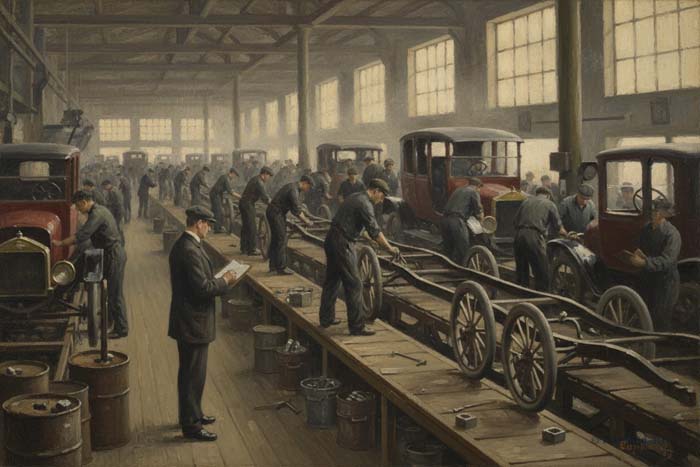
Workers at an early American automobile assembly line, circa 1913
Ford Highland Park Plant — the moving assembly line that changed manufacturing forever
Industry, Manufacturing & Transportation
The industrial immigrants who helped forge the physical infrastructure of modern America — its steel, its power grid, its factories, its aircraft, and its mass-market products.
Explore →
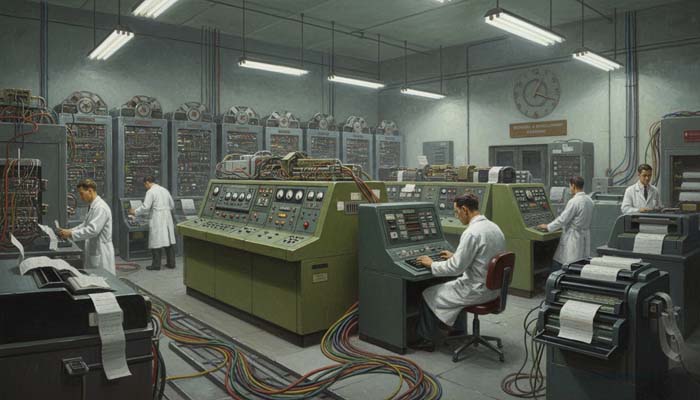
Scientists operating an early mainframe computer in a government research facility, 1950s
Early computing — the machines that launched the digital age
Technology, Computing & the Internet
The engineers, entrepreneurs, and visionaries who founded or built the technology companies that define the digital age — from the semiconductor revolution to the internet era.
Explore →
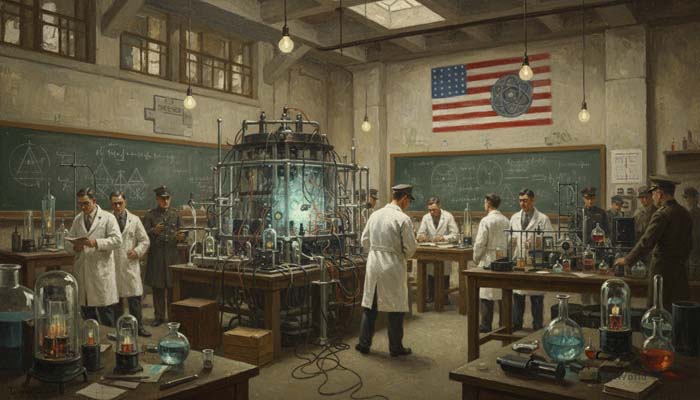
Scientists working in a Manhattan Project laboratory during World War II, with an American flag on the wall
The Manhattan Project laboratory — where immigrant scientists helped end World War II
Science, Physics & National Technology
The theoretical and experimental scientists — many of them refugees from European fascism and war — whose work in physics, mathematics, and aerospace shaped American science and national security for generations.
Explore →
Medical researchers working at a laboratory bench, early 20th century
The research laboratory — where vaccines and life-saving drugs were discovered
Medicine, Biology & Pharmaceuticals
The researchers, physicians, and pharmaceutical pioneers whose discoveries have reduced suffering, extended life, and transformed medicine — from vaccines and antibiotics to mRNA technology.
Explore →
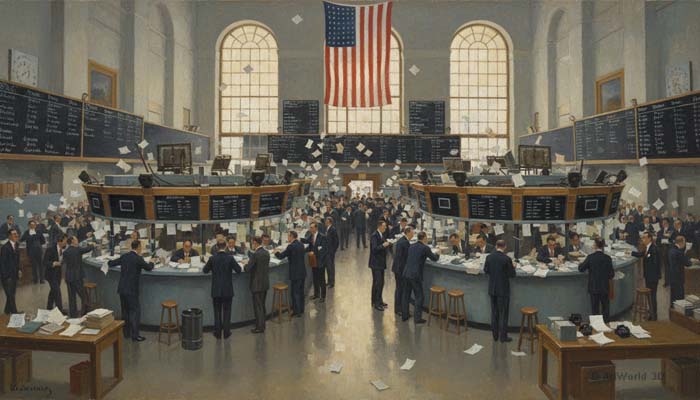
Traders crowding the floor of an early American stock exchange beneath an American flag
The stock exchange floor — built by immigrant bankers who financed a nation
Banking, Finance, Investing & Economics
The bankers, financiers, and economists who designed and built America's financial infrastructure — from Alexander Hamilton's founding architecture to the inventors of modern derivatives markets.
Explore →
The grand interior of an early American department store, with ornate balconies and crowds of shoppers
The American department store — created by immigrant entrepreneurs for a growing middle class
Retail, Consumer Goods & Entrepreneurship
The entrepreneurs who turned American commerce into a global force — creating the department store, the installment plan, modern cosmetics, mass-market clothing, and the fast-casual restaurant.
Explore →
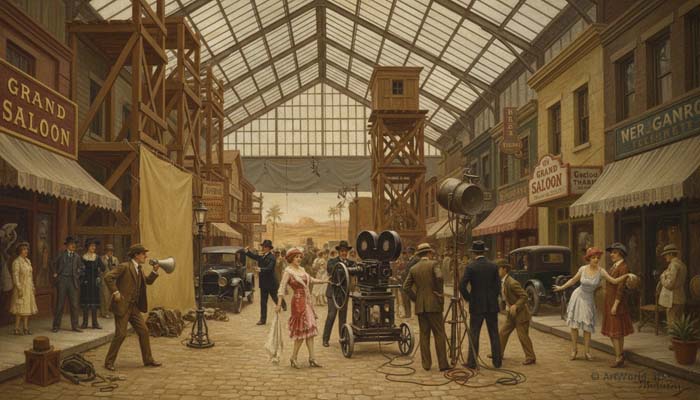
A bustling early Hollywood film studio street set with actors and crew, circa 1920s
Early Hollywood — built by immigrant founders who invented the studio system
Film, Television & Hollywood
The immigrant founders and filmmakers who built Hollywood from scratch — establishing the studio system, the feature film, the talking picture, and the sound of classic American cinema.
Explore →
Musicians and dancers at a jazz club during the 1920s American Jazz Age
The American jazz club — where immigrant musicians helped create a distinctly American sound
Music, Theater & Popular Culture
The composers, performers, and entertainers who created or defined the popular and concert music of America — from Tin Pan Alley and Broadway to the Hollywood film score and ballet.
Explore →
Workers operating a large industrial printing press in a newspaper press room, early 20th century
The newspaper press room — where immigrant publishers built the American free press
Journalism, Publishing & Communications
The editors, publishers, and journalists who built America's free press — from the colonial printer whose trial established the principle of press freedom to the magazine founders who shaped how a nation understood itself.
Explore →
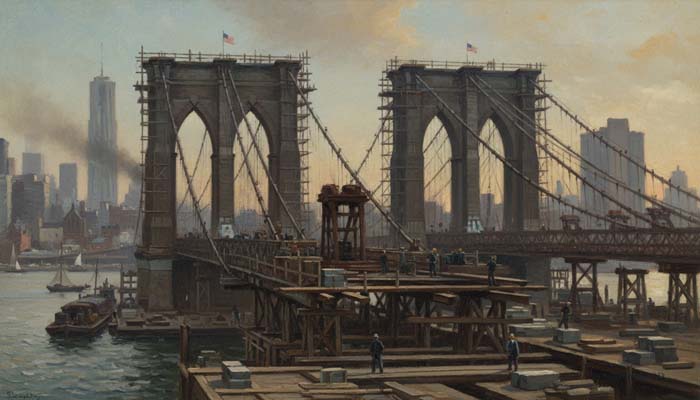
Construction of the Brooklyn Bridge over the East River, New York City, 1870s
The Brooklyn Bridge under construction — designed by German immigrant John Roebling
Architecture, Engineering, Design & the Built Environment
The architects and engineers who built the American skyline and landscape — the skyscrapers, suspension bridges, modernist houses, cultural institutions, and airports that define the country's built environment.
Explore →

Industry, Manufacturing & Transportation

A
Andrew Carnegie
1835–1919 · Scotland
Industry & Manufacturing
Arriving in America at 13 as a bobbin boy in a cotton factory, Carnegie worked his way to the dominant force in American steel. By 1900, Carnegie Steel produced more steel than all of Britain. When he sold to J.P. Morgan in 1901 for $480 million, the deal created U.S. Steel — then the world's largest corporation. He gave away nearly all of his fortune, funding 2,509 public libraries and founding Carnegie Mellon University.
“The man who dies rich dies disgraced.”
A
Alexander Graham Bell
1847–1922 · Scotland
Industry & Manufacturing
Bell filed his telephone patent on February 14, 1876 — hours before a competing application — and within a decade the Bell Telephone Company had strung wire across a nation hungry for instantaneous communication. His invention fundamentally altered commerce, emergency services, and social life, and the company he founded eventually became AT&T, one of the most influential corporations in American history.
“Before anything else, preparation is the key to success.”
N
Nikola Tesla
1856–1943 · Austrian Empire (now Croatia)
Industry & Manufacturing
Tesla's alternating current systems — which could transmit electricity over distances that Edison's direct current could not — won the War of Currents and made the electrification of America economically practical. His induction motor became the engine of the industrial age, and his Niagara Falls generating station lit Buffalo in 1895, demonstrating what the future of power would look like.
“The present is theirs; the future, for which I really worked, is mine.”
J
John Jacob Astor
1763–1848 · Germany
Industry & Manufacturing
Astor arrived in Baltimore in 1784 with little more than a few German flutes to sell, and died the richest person in America. He built his first fortune in the fur trade — his American Fur Company dominated the continent — then methodically converted those profits into Manhattan real estate, acquiring blocks of the city's most valuable land. His estate would be worth roughly $25 billion today.
“A man who has a million dollars is as well off as if he were rich.”
S
Samuel Slater
1768–1835 · England
Industry & Manufacturing
Slater memorized the design of English textile machinery — export of which was illegal — and sailed to America in disguise, reconstructing the first successful water-powered cotton-spinning mill at Pawtucket, Rhode Island, in 1793. That mill launched the American Industrial Revolution. Andrew Jackson called him 'the father of American manufactures,' and mill towns bearing Slater's design spread across New England.
“Whatever you do, do it well and thoroughly, and it will tell in the end.”
D
David Sarnoff
1891–1971 · Russian Empire
Industry & Manufacturing
Sarnoff arrived in New York at nine speaking no English, sold newspapers on the Lower East Side, and taught himself telegraphy. As head of RCA from 1930 to 1970, he launched America's first national radio network (NBC), introduced commercial television, and created the RCA Victor label that distributed much of the country's recorded music. Few individuals shaped the American media landscape more profoundly.
“Nobody can be successful unless he loves his work.”
I
Igor Sikorsky
1889–1972 · Russian Empire
Industry & Manufacturing
After the Bolshevik Revolution made his work impossible in Russia, Sikorsky came to America nearly penniless in 1919 and built a new aviation company from scratch. His VS-300 helicopter, which successfully flew in 1939, established the configuration — single main rotor, tail rotor — that virtually all helicopters still use. Sikorsky helicopters flew the first medivac missions, the first presidential transport, and the first open-sea rescues.
“The work of the individual still remains the spark that moves mankind forward.”
W
William Boeing
1881–1956 · U.S.-born, German immigrant father
Industry & Manufacturing
Boeing founded his aircraft company in Seattle in 1916, and by the time of World War II it had become the world's largest aircraft manufacturer — producing B-17 Flying Fortresses and B-29 Superfortresses central to Allied victory. The 707, which followed in the 1950s, launched the commercial jet age and effectively created the infrastructure for global air travel.
“We are all working together to a common end.”
H
Henry Ford
1863–1947 · U.S.-born, Irish and Belgian immigrant parents
Industry & Manufacturing
Ford did not invent the automobile, but his moving assembly line and the Model T — introduced in 1908 at a price ordinary Americans could afford — put cars within reach of the middle class and remade America's geography, economy, and culture. By 1927 more than 15 million Model Ts had been sold. His $5 daily wage, introduced in 1914, helped create the consumer economy that would define the 20th century.
“Whether you think you can or you think you can't, you're right.”
L
Levi Strauss
1829–1902 · Germany
Industry & Manufacturing
Strauss came to San Francisco during the Gold Rush as a dry-goods merchant and in 1873 partnered with Nevada tailor Jacob Davis to patent riveted denim work pants. What began as practical clothing for miners became the most globally recognized American garment in history — the uniform of the working class, then of youth culture, then of the world. Levi's jeans remain a uniquely American cultural export.
“The greatest pleasure a man can know is to do a good deed in secret and have it found out by accident.”

Technology, Computing & the Internet

S
Sergey Brin
1973– · Soviet Union
Technology & Computing
Brin came to Maryland with his family as a Jewish refugee from the Soviet Union at age six and went on to co-found Google with Larry Page at Stanford in 1998. Google's PageRank algorithm transformed how humanity accesses information, and the company grew into one of the most valuable corporations in history, reshaping advertising, computing, mobile communications, and artificial intelligence.
“You always hear that money doesn't buy happiness. I've always figured a lot of money will buy you a little bit of happiness.”
A
Andrew Grove
1936–2016 · Hungary
Technology & Computing
Grove survived the Nazi occupation of Hungary as a child, escaped the Communist regime in 1956, and arrived in New York speaking no English. As CEO of Intel from 1987 to 1998, he turned the company into the dominant manufacturer of microprocessors — the chips inside virtually every personal computer in the world. His book Only the Paranoid Survive became a defining management text of the technology era.
“Success breeds complacency. Complacency breeds failure. Only the paranoid survive.”
A
Andy Bechtolsheim
1955– · Germany
Technology & Computing
Bechtolsheim co-founded Sun Microsystems in 1982 and helped establish the technical architecture of networked computing. He is perhaps best known for writing a $100,000 check to 'Google Inc.' before the company was formally incorporated — becoming its first outside investor — a decision that made him a billionaire. He later co-founded Arista Networks, another major force in networking technology.
“The first step is you have to say that you can.”
V
Vinod Khosla
1955– · India
Technology & Computing
Khosla co-founded Sun Microsystems with Bechtolsheim in 1982 and later built one of Silicon Valley's most influential venture capital firms, Khosla Ventures, financing companies in technology, clean energy, and health care. His investments have shaped computing infrastructure, renewable energy development, and biotechnology across multiple decades of the technology revolution.
“The only difference between a caprice and a lifelong passion is that the caprice lasts a little longer.”
J
Jerry Yang
1968– · Taiwan
Technology & Computing
Yang came to California with his family at ten speaking virtually no English and co-founded Yahoo in 1995 while a graduate student at Stanford. Yahoo became one of the internet's first mass-market destinations — an email service, search engine, and news aggregator that introduced tens of millions of Americans to the web. At its peak in 2000, Yahoo was valued at more than $100 billion.
“In Silicon Valley, we tend to believe that anything you can imagine, you can build.”
J
Jan Koum
1976– · Soviet Ukraine
Technology & Computing
Koum grew up in a village outside Kyiv without hot water or telephone, came to California at 16, and worked as a janitor and grocery store clerk while learning programming. He co-founded WhatsApp in 2009 with a simple premise — messaging that works anywhere without fees — and built it to over a billion users before Facebook acquired it for $19 billion in 2014. His rags-to-riches story is among the most dramatic in Silicon Valley history.
“No ads! No games! No gimmicks!”
P
Pierre Omidyar
1967– · France (Iranian parents)
Technology & Computing
Omidyar built the prototype for eBay over a Labor Day weekend in 1995 as a project to help his fiancée trade Pez dispensers online, and within a year it had become a revolutionary marketplace enabling millions of individuals and small businesses to reach a global customer base. He became a billionaire at 31 and has since devoted much of his wealth to philanthropy and investigative journalism.
“I had a vision of using the internet to create a marketplace where normal people could buy and sell things.”
E
Elon Musk
1971– · South Africa
Technology & Computing
Musk came to North America in his late teens and within three decades had built Tesla (transforming electric vehicles into a mass-market product), SpaceX (the first private company to send astronauts to the International Space Station), and Starlink (a global satellite internet network). His companies have simultaneously reshaped automotive manufacturing, aerospace, and communications in ways no individual had previously managed.
“When something is important enough, you do it even if the odds are not in your favor.”
J
Jensen Huang
1963– · Taiwan
Technology & Computing
Huang co-founded NVIDIA in 1993 to build graphics processing units for gaming, but the GPU's capacity for parallel computation proved to have revolutionary applications far beyond games. NVIDIA's chips became the essential infrastructure of artificial intelligence, machine learning, and scientific computing — making the company one of the most valuable in the world by the 2020s. Huang's long-term technical vision proved among the most consequential bets in technology history.
“Software is eating the world, but AI is going to eat software.”
S
Steve Jobs
1955–2011 · U.S.-born, biological father a Syrian immigrant
Technology & Computing
Jobs co-founded Apple in a garage at 21, was pushed out of his own company, returned to rescue it from near-bankruptcy, and proceeded to invent the iMac, iPod, iTunes, iPhone, and iPad in succession — transforming personal computing, the music industry, the telephone, and tablets in turn. Apple under Jobs became the most valuable company in American history and permanently altered how human beings interact with technology.
“Your work is going to fill a large part of your life, and the only way to be truly satisfied is to do what you believe is great work.”

Science, Physics & National Technology

A
Albert Einstein
1879–1955 · Germany
Science & Physics
Einstein arrived in America as a refugee from Nazi Germany in 1933 and never returned to Europe. His special and general theories of relativity transformed physics, and his famous letter to President Roosevelt in 1939 helped initiate the Manhattan Project. His mass-energy equivalence — E=mc² — became the most famous equation in history. He won the Nobel Prize in Physics in 1921 for the photoelectric effect.
“Imagination is more important than knowledge.”
E
Enrico Fermi
1901–1954 · Italy
Science & Physics
Fermi fled Fascist Italy in 1938 after collecting his Nobel Prize in Stockholm, went directly to America, and at the University of Chicago on December 2, 1942, achieved the first self-sustaining nuclear chain reaction — in a squash court under the football stadium — inaugurating the nuclear age. He was among the most gifted experimental and theoretical physicists of the 20th century.
“Whatever nature has in store for mankind, unpleasant as it may be, men must accept, for ignorance is never better than knowledge.”
J
John von Neumann
1903–1957 · Hungary
Science & Physics
Von Neumann was regarded by his contemporaries as possibly the quickest mind in America. He made foundational contributions to quantum mechanics, game theory, economics, set theory, and computing — including the von Neumann architecture that underlies virtually every digital computer ever built. He also played a crucial role in the Manhattan Project and the development of hydrogen bomb technology.
“If people do not believe that mathematics is simple, it is only because they do not realize how complicated life is.”
E
Edward Teller
1908–2003 · Hungary
Science & Physics
Teller fled Hungary, then Nazi Germany, and settled in America where he worked on the Manhattan Project and became the principal scientific architect of the hydrogen bomb. He was a central and controversial figure in American nuclear policy for decades, and his testimony against J. Robert Oppenheimer at the latter's security clearance hearing made him permanently unpopular with much of the scientific community.
“No endeavor that is worthwhile is simple in prospect; if it is right, it will be simple in retrospect.”
L
Leo Szilard
1898–1964 · Hungary
Science & Physics
Szilard conceived the nuclear chain reaction in 1933 while crossing a London street and later co-patented the nuclear reactor with Fermi. Horrified at the prospect of Nazi Germany developing atomic weapons first, he drafted the letter from Einstein to Roosevelt that set the Manhattan Project in motion — making him the catalyst for the most consequential scientific undertaking in history. He spent his final years working for nuclear disarmament.
“A scientist's aim in a discussion with his colleagues is not to persuade, but to clarify.”
H
Hans Bethe
1906–2005 · Germany
Science & Physics
Bethe came to Cornell in 1935 after being fired from his German professorship when the Nazis took power, headed the theoretical division of the Manhattan Project at Los Alamos, later helped develop the hydrogen bomb, and won the Nobel Prize in Physics in 1967 for explaining how stars generate energy through nuclear fusion. He remained intellectually active past the age of 90.
“I have done my share.”
S
Subrahmanyan Chandrasekhar
1910–1995 · India
Science & Physics
Chandrasekhar sailed to Cambridge as a 19-year-old and calculated en route what became known as the Chandrasekhar limit — the mass above which a star cannot stabilize as a white dwarf and must collapse. The insight was rejected for decades by the great British astrophysicist Arthur Eddington. When the Nobel Committee finally honored Chandrasekhar in 1983, the citation described his work as 'one of the greatest insights in the history of science.'
“The pursuit of science has often been compared to the scaling of mountains, high and not so high.”
C
Chien-Shiung Wu
1912–1997 · China
Science & Physics
Wu came to the United States in 1936 for graduate school and became one of the most experimentally gifted physicists of the 20th century. Her 1956 experiment disproving the conservation of parity in weak nuclear interactions confirmed a prediction by Lee and Yang — who received the Nobel Prize for the prediction. Wu, whose experiment proved it, did not. She was honored with virtually every other major scientific award.
“I wonder whether the fact that I have always been pushing and setting goals for myself has anything to do with the fact that I am the first daughter of an immigrant family that had to fight to survive.”
G
George Gamow
1904–1968 · Russian Empire
Science & Physics
Gamow defected from the Soviet Union in 1933 and came to the United States, where he made major contributions to nuclear physics and developed the Big Bang nucleosynthesis theory — explaining how the light elements were forged in the first minutes after the universe began. He was also an inspired science communicator whose 'Mr. Tompkins' books made physics accessible to generations of readers.
“If you are not somewhat confused by quantum mechanics, you have not understood it.”
W
Wernher von Braun
1912–1977 · Germany
Science & Physics
Von Braun designed the V-2 rocket that struck London in World War II, and after the war was brought to America in Operation Paperclip, where he put his genius to work for NASA. He designed the Saturn V rocket that carried Apollo astronauts to the moon — the largest and most powerful machine ever to fly successfully. His past collaboration with the Nazi regime remained a moral cloud over one of the most consequential engineering careers of the century.
“Research is what I'm doing when I don't know what I'm doing.”

Medicine, Biology & Pharmaceuticals

J
Jonas Salk
1914–1995 · U.S.-born, Russian-Jewish immigrant parents
Medicine & Biology
Salk's inactivated polio vaccine, announced on April 12, 1955, was greeted with spontaneous celebrations across the country. He refused to patent the vaccine, forgoing an estimated $7 billion in royalties, telling Edward R. Murrow it belonged to 'the people.' The Salk Institute for Biological Studies in La Jolla, designed by Louis Kahn, became one of the world's leading research institutions.
“The reward for work well done is the opportunity to do more.”
A
Albert Sabin
1906–1993 · Russian Empire (now Poland)
Medicine & Biology
Sabin came to America as a Jewish refugee in 1921 and developed the oral polio vaccine — taken on a sugar cube — that proved simpler to administer than Salk's injected version and more effective at creating community immunity. His vaccine has been used in the global eradication campaign that reduced polio from 350,000 cases per year in 1988 to fewer than 20 by the 2020s.
“I have never had the temptation to work for profit.”
S
Selman Waksman
1888–1973 · Russian Empire (now Ukraine)
Medicine & Biology
Waksman came to New Jersey in 1910, studied soil microbiology, and in 1943 discovered streptomycin — the first effective treatment for tuberculosis, which was killing 50,000 Americans per year. He coined the word 'antibiotic' and won the Nobel Prize in Physiology or Medicine in 1952. His discovery saved hundreds of millions of lives and established the pharmaceutical model of deriving drugs from soil organisms.
“Wherever we look upon this earth, the opportunities take shape within the problems.”
K
Katalin Karikó
1955– · Hungary
Medicine & Biology
Karikó spent decades pursuing mRNA as a therapeutic platform while being demoted, denied grants, and widely dismissed at the University of Pennsylvania. Her key insight — that chemically modifying mRNA made it acceptable to the immune system — enabled the technology that became the COVID-19 vaccines. The Nobel Prize in Physiology or Medicine followed in 2023, forty years after she began the work.
“There is always a way. You just have to keep going.”
A
Albert Claude
1899–1983 · Belgium
Medicine & Biology
Claude came to the Rockefeller Institute in the 1920s and developed the technique of differential centrifugation — spinning cells at different speeds to separate their components — essentially inventing cell fractionation and making modern cell biology possible. He shared the Nobel Prize in Physiology or Medicine in 1974 for his role in establishing the biochemistry of the cell.
“It is the destiny of the scientist to be an eternal student.”
R
Renato Dulbecco
1914–2012 · Italy
Medicine & Biology
Dulbecco came to the United States in 1947 and at the Salk Institute did pioneering work on tumor viruses — demonstrating that cancer-causing viruses insert their genetic material into the DNA of host cells. He shared the 1975 Nobel Prize in Physiology or Medicine and later proposed the Human Genome Project, the effort to sequence all human DNA that transformed 21st-century medicine.
“The secret of science is that it has to be done.”
B
Baruch Blumberg
1925–2011 · U.S.-born, immigrant Jewish parents
Medicine & Biology
Blumberg discovered the hepatitis B antigen in 1967 while searching for inherited proteins in blood samples from around the world. The discovery led directly to a blood test for hepatitis B — making the blood supply safer — and then to the development of the first vaccine against a human cancer, since hepatitis B causes liver cancer. He won the Nobel Prize in Physiology or Medicine in 1976.
“Scientific research is one of the most exciting and rewarding of occupations.”
D
David Ho
1952– · Taiwan
Medicine & Biology
Ho came to California at 12 speaking no English and became one of America's leading researchers on HIV/AIDS. In the 1990s, he pioneered combination antiretroviral therapy — the drug cocktail that transformed AIDS from a death sentence to a manageable chronic illness. Time magazine named him Person of the Year in 1996 for work estimated to have saved millions of lives.
“The beauty of science is that it's self-correcting.”
G
George Papanicolaou
1883–1962 · Greece
Medicine & Biology
Papanicolaou came to New York in 1913 and spent decades at Cornell studying vaginal cytology. His Pap smear test, developed in the 1940s, detects cervical cancer in its early, treatable stages. It has reduced cervical cancer deaths in the United States by more than 70 percent since its widespread adoption — making it among the most effective cancer-screening tools ever devised.
“I have devoted my whole life to medical science.”
C
Charles Pfizer
1824–1906 · Germany
Medicine & Biology
Pfizer came to New York in 1848 with a cousin, $2,500 in borrowed capital, and a chemistry background. Their first product — a palatable form of santonin, a medicine for intestinal parasites — succeeded, and Charles Pfizer & Company grew steadily through the Civil War supplying medicines to the Union Army. The company Pfizer left behind became one of the world's largest pharmaceutical manufacturers.
“The secret of success is to do common work uncommonly well.”

Banking, Finance, Investing & Economics

A
Alexander Hamilton
1755–1804 · Nevis, British West Indies
Banking & Finance
Hamilton arrived in New York from the Caribbean as an orphan teenager, rose by merit through the Revolutionary War to become Washington's most trusted aide, and as the first Treasury Secretary designed the American financial system from scratch — establishing the national bank, federal credit, assumption of state debts, and the customs service. His vision of an industrial, commercially powerful America was foundational to everything that followed.
“Those who stand for nothing fall for anything.”
J
Joseph Seligman
1819–1880 · Germany
Banking & Finance
Seligman arrived in Pennsylvania in 1837 as a penniless teenager and built J. & W. Seligman & Company into one of the most important investment banks in 19th-century America. During the Civil War he helped finance the Union government by selling American bonds in Europe when few would buy them, and he later financed railroads and industrial expansion across the country.
“I have always found that to be honest is the best policy.”
M
Marcus Goldman
1821–1904 · Germany
Banking & Finance
Goldman came to Philadelphia in 1848, eventually moved to New York, and in 1869 founded Marcus Goldman & Co. — buying commercial paper from merchants and selling it to banks at a profit. His son-in-law Samuel Sachs joined the firm, which became Goldman Sachs, one of the most influential financial institutions in the world for more than 150 years.
“The worth of a man must be measured by his life, not by his death.”
J
Jacob Schiff
1847–1920 · Germany
Banking & Finance
Schiff came to America after the Civil War, became head of Kuhn, Loeb & Company, and financed some of the most consequential railroad projects in American history, including the transcontinental Union Pacific and Northern Pacific lines. He declined to finance Russia's government in protest of its treatment of Jews, instead financing Japan during the Russo-Japanese War — one of the most consequential acts of private financial diplomacy in history.
“An honorable man is one who is truly honest.”
J
Jules Bache
1861–1944 · Germany
Banking & Finance
Bache built J.S. Bache & Co. into one of America's largest retail brokerage firms, with offices across the country, helping to make stock-market investment accessible to ordinary Americans at a time when financial markets were largely the province of the wealthy. He was also a major art collector, donating his collection to the Metropolitan Museum of Art.
“The wise investor knows that the road to wealth is paved with patience.”
F
Felix Warburg
1871–1937 · Germany
Banking & Finance
Warburg came to New York in 1894, married into the Schiff family, and became a senior partner at Kuhn, Loeb. A major philanthropist, he helped found the Federation for the Support of Jewish Philanthropic Societies and donated his Manhattan mansion — now the Jewish Museum — to the public. His banking career and philanthropic network made him one of the most influential figures in American Jewish life.
“The human spirit is almost indestructible.”
T
Thomas Peterffy
1944– · Hungary
Banking & Finance
Peterffy escaped Communist Hungary in 1956 and came to America speaking no English. He worked as a draftsman, taught himself programming, and in the 1970s began using computers to trade options on the American Stock Exchange — becoming a pioneer of electronic trading at a time when all transactions were done on paper. His firm Interactive Brokers democratized access to financial markets and made him one of America's wealthiest individuals.
“Freedom is not a birthright. It has to be defended, cherished, and nurtured.”
G
George Soros
1930– · Hungary
Banking & Finance
Soros survived the Nazi occupation of Budapest as a teenager and escaped Communist Hungary in 1947. His Quantum Fund produced some of the best investment returns in financial history. He became internationally known when he 'broke the Bank of England' in 1992 by betting against the pound — earning $1 billion in a single day. He has given more than $32 billion to his Open Society Foundations.
“It's not whether you're right or wrong that's important, but how much money you make when you're right and how much you lose when you're wrong.”
M
Michael Milken
1946– · U.S.-born, immigrant-descended family
Banking & Finance
Milken transformed the American corporate financing landscape in the 1970s and 1980s by championing high-yield bonds — 'junk bonds' — as a legitimate source of capital for growing companies that lacked investment-grade credit ratings. The financing he arranged enabled the growth of companies employing hundreds of thousands of workers and reshaped industries from telecommunications to healthcare. He was later pardoned after a securities conviction ended his Wall Street career.
“I learned more about business from my first job than from my MBA.”
M
Myron Scholes
1941– · Canada
Banking & Finance
Scholes worked with Fischer Black at the University of Chicago to develop the Black-Scholes model — a mathematical formula for pricing options contracts — published in 1973 and arguably the most consequential paper in the history of finance. It gave traders a rational basis for pricing derivatives and helped create the global derivatives market. Scholes received the Nobel Prize in Economics in 1997.
“The goal of financial theory is to understand the structure of equilibrium prices.”

Retail, Consumer Goods & Entrepreneurship

I
Isaac Singer
1811–1875 · U.S.-born, German immigrant parents
Retail & Entrepreneurship
Singer did not invent the sewing machine but made it commercially dominant through radical business innovation — installment payment plans, aggressive advertising, international distribution, and franchised dealers — that put a $125 machine within reach of ordinary households. By the 1860s, the Singer Manufacturing Company was the world's largest manufacturer of sewing machines and a pioneer of modern consumer-products marketing.
“If I had thought about it, I wouldn't have done the experiment. The literature was full of examples that said you can't do this.”
E
Estée Lauder
1908–2004 · U.S.-born, Hungarian and Czech Jewish immigrant parents
Retail & Entrepreneurship
Lauder began selling her uncle's face cream from a beauty shop in New York and built, through relentless personal salesmanship and a conviction that every woman deserved to feel beautiful, what became one of the largest cosmetics companies in the world. Her strategy of giving away free samples — 'giving with love,' she called it — was considered eccentric until it became standard industry practice.
“I have never worked a day in my life without selling. If I believe in something, I sell it, and I sell it hard.”
M
Max Factor
1877–1938 · Russian Empire (now Poland)
Retail & Entrepreneurship
Factor came to Los Angeles in 1908 to supply makeup to the film industry, invented flexible greasepaint that photographed naturally on moving actors, and in doing so created the modern cosmetics industry. His products moved from film sets to department store counters, and his 'Society Makeup' was the first to suggest that ordinary women could use theatrical cosmetics. The common noun 'makeup' was popularized by Factor.
“Makeup is the greatest invention since clothing.”
H
Helena Rubinstein
1872–1965 · Poland
Retail & Entrepreneurship
Rubinstein came to Australia in 1902, then to London, then to New York, building a global luxury cosmetics empire through sheer force of personality, scientific marketing, and a relentless emphasis on the skin-care science underlying her products. She and Elizabeth Arden defined American luxury beauty for decades, competing ferociously. At her death her estate was valued at $100 million.
“There are no ugly women, only lazy ones.”
L
Liz Claiborne
1929–2007 · Belgium (American parents)
Retail & Entrepreneurship
Claiborne co-founded Liz Claiborne Inc. in 1976 at age 47 to make affordable, stylish, practical clothing for working women — a category that American fashion had largely ignored. The company became the first founded by a woman to make the Fortune 500, and its success transformed American ready-to-wear by treating working women as a serious and underserved market.
“I created Liz Claiborne for women like myself: real women with real lives.”
A
Amadeo Giannini
1870–1949 · U.S.-born, Italian immigrant parents
Retail & Entrepreneurship
Giannini founded the Bank of Italy in San Francisco in 1904 with the explicit purpose of serving ordinary working people — immigrants, farmers, and small-business owners whom existing banks ignored. He brought banking to the street corner, pioneered branch banking, extended home mortgages to the middle class, and financed the Golden Gate Bridge. His bank became Bank of America.
“I am no longer working for money. I want to see what I can do for the people.”
I
Isidor Straus
1845–1912 · Germany
Retail & Entrepreneurship
Straus came to America as a child refugee during the Civil War and built Macy's, with his brother Nathan, into the largest department store in the world. He and Nathan Straus also ran the crockery and china department of Macy's, which gave them the foothold that eventually allowed them to take ownership. Isidor and his wife Ida were among the last to board a lifeboat on the Titanic, choosing instead to remain together on deck.
“We have lived together for so many years. Where you go, I go.”
N
Nathan Straus
1848–1931 · Germany
Retail & Entrepreneurship
Straus built Macy's alongside his brother Isidor but is best remembered as a public health philanthropist of remarkable impact. He campaigned for the pasteurization of milk — establishing free pasteurized milk stations across New York at his own expense — at a time when contaminated milk was killing thousands of children per year. Pasteurization became mandatory in New York City in 1913, largely because of his advocacy.
“What you give to the poor, you lend to God.”
A
Andrew Cherng
1948– · China
Retail & Entrepreneurship
Cherng came to America in the 1970s and with his father opened the first Panda Inn in Pasadena in 1973. With his wife Peggy, he developed the Panda Express fast-casual format and built it into the largest Chinese restaurant chain in the country — with thousands of locations and billions in annual revenue. Their Panda Cares Foundation has donated hundreds of millions to education and disaster relief.
“Every day, work harder on yourself than you do on your business.”
H
Hamdi Ulukaya
1972– · Turkey
Retail & Entrepreneurship
Ulukaya came to New York as a young man to study English and stayed to build Chobani into one of the most successful food companies in America. He bought a defunct Kraft yogurt plant in upstate New York in 2005 and within a decade had created the most popular Greek yogurt brand in the country, bringing billions in revenue and thousands of jobs — many filled by refugees — to economically depressed communities.
“Business can be good and do good at the same time.”

Film, Television & Hollywood

L
Louis B. Mayer
1884–1957 · Russian Empire
Film & Television
Mayer came to Canada as a child from the Pale of Settlement and crossed into the United States to acquire a rundown theater in Haverhill, Massachusetts. He moved to Hollywood, co-founded Metro-Goldwyn-Mayer in 1924, and built it into the most prestigious studio of Hollywood's golden age — home to Greta Garbo, Clark Gable, and Judy Garland — earning the phrase 'More stars than there are in heaven.'
“I work with the best actors, directors, writers — only the best. If you work with the best, you will produce the best.”
S
Samuel Goldwyn
1879–1974 · Russian Empire (now Poland)
Film & Television
Goldwyn came to America at 11, worked in a glove factory, and entered the film business in 1913 by producing the first feature-length Hollywood Western. He eventually formed his own independent production company and produced some of the most celebrated films of the golden age, including Wuthering Heights, The Best Years of Our Lives, and Guys and Dolls.
“A wide screen just makes a bad film twice as bad.”
A
Adolph Zukor
1873–1976 · Hungary
Film & Television
Zukor came to New York at 16 with $40 sewn inside his vest and worked as a furrier before entering the nickelodeon business. He introduced the feature-length film to American audiences in 1912 and founded the company that became Paramount Pictures, the oldest surviving Hollywood studio. He lived to be 103 — long enough to see the industry he created transformed by television, video, and cable.
“If you have a good story and a good director, you have a good picture.”
W
William Fox
1879–1952 · Hungary
Film & Television
Fox came to New York as an infant, grew up in poverty on the Lower East Side, and founded the Fox Film Corporation. He pioneered the use of sound in film through Movietone — the technology that made the talking picture commercially practical — before losing his company in the Depression. The studio he founded became 20th Century Fox, one of the most enduring names in Hollywood.
“The talking picture will take the place of a great deal of the other industries.”
C
Carl Laemmle
1867–1939 · Germany
Film & Television
Laemmle came to Oshkosh, Wisconsin in 1884 as a young German immigrant and decades later founded Universal Pictures, the oldest surviving major Hollywood studio. He battled Thomas Edison's Motion Picture Patents Company, helped create the independent film industry, and invented the star system — making actors famous by publicizing their names — when Edison's trust refused to identify performers by name.
“Look at the man who is successful. The chances are a hundred to one he is earnest.”
H
Harry Warner
1881–1958 · Russian Empire (now Poland)
Film & Television
Harry Warner was the eldest of the four Warner brothers, who came to America as children from the Pale of Settlement. As president of Warner Bros., he oversaw the studio's pivotal decision to invest in sound technology, producing The Jazz Singer in 1927 and launching the sound era of American film — arguably the most transformative single business decision in the history of Hollywood.
“I'm not interested in being understood. I'm interested in being successful.”
J
Jack Warner
1892–1978 · Canada (Polish-Jewish immigrant parents)
Film & Television
The youngest and longest-lived of the Warner brothers, Jack Warner ran the studio's Hollywood production operations for decades. He oversaw films from Casablanca and Yankee Doodle Dandy to My Fair Lady and Bonnie and Clyde — a filmography spanning the golden age into the New Hollywood era that made Warner Bros. one of the most consistently successful studios in history.
“I've never met a man I didn't like, unless you count studio executives.”
B
Billy Wilder
1906–2002 · Austrian Empire (now Poland)
Film & Television
Wilder fled Germany in 1933 — his mother and grandmother later died in Auschwitz — learned English from a dictionary on the boat to New York, and became one of the greatest writer-directors in Hollywood history. His films include Double Indemnity, Sunset Boulevard, Stalag 17, Some Like It Hot, and The Apartment — winning six Academy Awards across comedy, film noir, drama, and satire.
“Trust your own instinct. Your mistakes might as well be your own, instead of someone else's.”
F
Frank Capra
1897–1991 · Italy
Film & Television
Capra came from Sicily to Los Angeles at six and directed the films that defined the image of decent, ordinary Americans standing up against corruption: It Happened One Night, Mr. Smith Goes to Washington, Meet John Doe, and It's a Wonderful Life. No director did more to articulate the moral and democratic ideals of American life on film.
“There are no rules in filmmaking. Only sins. And the cardinal sin is dullness.”
C
Charlie Chaplin
1889–1977 · England
Film & Television
Chaplin came to America in 1910 as part of a music hall touring company and created 'the Tramp' — possibly the most universally recognized character in cinema history. His films The Kid, The Gold Rush, City Lights, Modern Times, and The Great Dictator established him as the dominant figure of silent and early sound cinema. He co-founded United Artists in 1919 with Pickford, Fairbanks, and Griffith to give artists control of their own work.
“A day without laughter is a day wasted.”

Music, Theater & Popular Culture

I
Irving Berlin
1888–1989 · Russian Empire
Music & Culture
Berlin came to New York's Lower East Side at five, was selling newspapers on the street at nine after his father died, and grew up to write over 1,500 songs — including 'God Bless America,' 'White Christmas' (the best-selling single of all time until 1997), 'Easter Parade,' and 'There's No Business Like Show Business.' He was entirely self-taught and could only play in one key.
“Life is 10 percent what you make it and 90 percent how you take it.”
G
George Gershwin
1898–1937 · U.S.-born, Russian-Jewish immigrant parents
Music & Culture
Gershwin dropped out of school at 15 to plug songs on Tin Pan Alley and became the composer who most successfully synthesized jazz and classical traditions into a distinctly American idiom. Rhapsody in Blue, An American in Paris, and the opera Porgy and Bess were recognized in his short lifetime as masterworks that transcended the popular/classical divide. He died of a brain tumor at 38.
“Life is a lot like jazz. It's best when you improvise.”
I
Ira Gershwin
1896–1983 · U.S.-born, Russian-Jewish immigrant parents
Music & Culture
Ira Gershwin wrote the words for most of his brother George's songs and, after George's early death, continued collaborating with composers including Kurt Weill and Jerome Kern. His lyrical sophistication — witty, colloquial, and emotionally precise — defined the American popular song and influenced every lyricist who followed. He won the Pulitzer Prize with George for Of Thee I Sing in 1932.
“A lyric is an emotional shorthand — and the song does what the words can't do alone.”
A
Al Jolson
1886–1950 · Russian Empire (now Lithuania)
Music & Culture
Jolson came to Washington, D.C. as a child and became the most successful entertainer in America during the first quarter of the 20th century through an explosive performance style that electrified vaudeville and Broadway audiences. He starred in The Jazz Singer in 1927 — the first commercially successful sound film — delivering the first spoken dialogue in a feature film.
“You ain't heard nothin' yet!”
S
Sergei Rachmaninoff
1873–1943 · Russian Empire
Music & Culture
Rachmaninoff came to America in 1918 after the Bolshevik Revolution and divided the rest of his life between concertizing and composing. His recordings as a pianist — made in the 1920s and 1930s — are among the most prized in the history of recorded music. His Second and Third Piano Concertos and Rhapsody on a Theme of Paganini became beloved staples of the concert repertoire.
“Music is enough for a lifetime, but a lifetime is not enough for music.”
D
Dimitri Tiomkin
1894–1979 · Russian Empire (now Ukraine)
Music & Culture
Tiomkin came to New York in 1925 and became the most celebrated film composer of Hollywood's golden age, winning four Academy Awards and scoring Westerns and epics that defined the sound of American cinema: High Noon, Giant, Gunfight at the O.K. Corral, and The Alamo. He famously thanked 'Brahms, Beethoven, Bach, Strauss, Johann Strauss, Richard Strauss...' at his Oscar acceptance speech.
“Music in films must be an emotional shorthand for what the director cannot say.”
M
Max Steiner
1888–1971 · Austria-Hungary
Music & Culture
Steiner came to New York in 1914 and eventually moved to Hollywood, where as music director for RKO and then Warner Bros. he pioneered the use of original orchestral scores for motion pictures. His score for King Kong (1933) set the template for film music, and his later work on Casablanca, Now, Voyager, and Gone with the Wind defined what we mean by the classic Hollywood sound.
“The music tells the story when the words cannot.”
E
Erich Wolfgang Korngold
1897–1957 · Austria-Hungary
Music & Culture
Korngold was considered by Mahler and Puccini to be one of the greatest musical prodigies of the age. He came to Hollywood in 1934 and invented the lush, orchestral adventure-film score with The Adventures of Robin Hood (1938), for which he won the Academy Award. John Williams has cited his work as a direct inspiration for the Star Wars score.
“I have always written what I felt, and I shall always do so.”
B
Bob Hope
1903–2003 · England
Music & Culture
Hope came to Cleveland as a child and became one of the most successful and durable entertainers in American history — in vaudeville, Broadway, radio, film, and television. His annual Christmas tours to entertain American troops overseas, conducted from World War II through the Gulf War, made him a beloved national institution. He received five honorary Academy Awards and the Presidential Medal of Freedom.
“A bank is a place that will lend you money if you can prove that you don't need it.”
M
Mikhail Baryshnikov
1948– · Soviet Union (now Latvia)
Music & Culture
Baryshnikov defected from the Soviet Union during a Canadian tour in 1974 and joined American Ballet Theatre, where he became the most celebrated male ballet dancer of his generation — and then stretched into modern dance, acting, and choreography. His work with choreographers Twyla Tharp, Mark Morris, and Paul Taylor expanded what ballet dancers were expected to do.
“No matter what country you are in, art is a universal language.”

Journalism, Publishing & Communications

J
Joseph Pulitzer
1847–1911 · Hungary
Journalism & Publishing
Pulitzer came to St. Louis in 1864 to serve in the Union Army, learned English by reading in the library, and bought the New York World in 1883, transforming it into a populist powerhouse — pioneering investigative reporting, graphic headlines, and illustration. He funded the Statue of Liberty's pedestal by printing the names of 120,000 donors in his paper. His will endowed the Pulitzer Prizes.
“Newspapers are the university of the poor.”
H
Henry Luce
1898–1967 · China (American missionary parents)
Journalism & Publishing
Luce was born in Shandong province and came to America for school, co-founding Time magazine in 1923, Fortune in 1930, Life in 1936, and Sports Illustrated in 1954. His publications reached millions of Americans weekly and shaped how the country understood news, business, culture, and sport. He declared the 20th century 'the American Century' in a 1941 editorial.
“I became a journalist to come as close as possible to the heart of the world.”
A
Arianna Huffington
1950– · Greece
Journalism & Publishing
Huffington came to Cambridge University from Athens and eventually made her base in America, co-founding The Huffington Post in 2005 — one of the first news organizations to demonstrate that aggregation, blogging, and social media could drive massive audience traffic. The site was acquired by AOL for $315 million in 2011. She later founded Thrive Global and became a leading voice in media entrepreneurship.
“Fearlessness is not the absence of fear. It's the mastery of fear.”
T
Tina Brown
1953– · England
Journalism & Publishing
Brown came to New York in 1983 to edit Vanity Fair, which she transformed from a failing magazine into a cultural institution, then edited The New Yorker from 1992 to 1998, dramatically changing its visual style, pace, and cultural reach. She later founded the Daily Beast and the Women in the World Summit. She is widely regarded as the most influential magazine editor in late 20th-century American journalism.
“The key to great editing is knowing what to leave in and what to take out.”
R
Rupert Murdoch
1931– · Australia
Journalism & Publishing
Murdoch came to America in 1974 to acquire the New York Post, became a naturalized citizen in 1985 to qualify for U.S. broadcast licenses, and built News Corporation and later Fox Corporation into a global media empire. Fox News, launched in 1996, became the most watched cable news network in America and transformed the political media landscape in ways that continue to unfold.
“In motivating people, you've got to engage their minds and their hearts.”
T
Ted Koppel
1940– · England (German-Jewish refugee parents)
Journalism & Publishing
Koppel came to America as a child refugee whose parents had fled Nazi Germany and built one of the most distinguished careers in American broadcast journalism. He anchored ABC's Nightline from 1980 to 2005 — originally created to cover the Iran hostage crisis — bringing depth, preparation, and intellectual rigor to television news in a format it had rarely seen.
“The responsibility of the press is to comfort the afflicted and to afflict the comfortable.”
M
Mike Wallace
1918–2012 · U.S.-born, Russian-Jewish immigrant parents
Journalism & Publishing
Wallace pioneered the tough, confrontational television interview — using silence, the unexpected question, and exhaustive preparation to extract candid answers from the powerful — as a cornerstone of 60 Minutes from its launch in 1968 until 2006. His interviews with Ayatollah Khomeini, Malcolm X, and hundreds of other major figures are models of adversarial journalism.
“I've always been a reporter. It's been my life.”
W
Walter Winchell
1897–1972 · U.S.-born, Russian-Jewish immigrant parents
Journalism & Publishing
Winchell invented the modern gossip column, syndicated in over 2,000 newspapers at his peak, and his radio broadcast — 'Good evening, Mr. and Mrs. America and all the ships at sea' — was heard by an estimated 50 million listeners. He helped define the fusion of celebrity news, crime reporting, and political commentary that characterizes American tabloid culture to this day.
“A real friend is one who walks in when the rest of the world walks out.”
A
Arthur Ochs Sulzberger
1926–2012 · U.S.-born, German-Jewish immigrant newspaper family
Journalism & Publishing
Sulzberger served as publisher of The New York Times from 1963 to 1992, overseeing its decision to publish the Pentagon Papers over the government's objections in 1971 — a defining act of press freedom — and expanding the paper's national and international reach. Under his leadership the Times established itself as America's preeminent national newspaper.
“The duty of a newspaper is to comfort the afflicted and afflict the comfortable.”
J
John Peter Zenger
1697–1746 · Germany
Journalism & Publishing
Zenger came to New York as an indentured servant and became the printer and publisher of the New-York Weekly Journal. When he was charged with seditious libel by the royal governor for printing criticism of the government in 1734, his lawyer Andrew Hamilton argued that truth should be a defense against libel — and the jury acquitted him. The Zenger case became the foundational precedent for American press freedom.
“The question before the court is not the cause of a poor printer — it is the cause of every free man that lives under a British government.”

Architecture, Engineering, Design & the Built Environment

I
I. M. Pei
1917–2019 · China
Architecture & Engineering
Pei came to the United States at 18, studied at MIT and Harvard under Walter Gropius, and built a career spanning seven decades encompassing the National Gallery of Art East Building, the Louvre Pyramid, the Rock and Roll Hall of Fame, and dozens of other major public buildings. He became the preeminent architect of public cultural institutions in the late 20th century.
“Architecture is the art of how to waste space.”
L
Ludwig Mies van der Rohe
1886–1969 · Germany
Architecture & Engineering
Mies van der Rohe came to America in 1937 to direct the architecture school at the Illinois Institute of Technology, and in Chicago designed the school's campus, the glass-and-steel Seagram Building in New York, and the Farnsworth House — buildings that defined the International Style and established glass-box modernism as the dominant architectural idiom of postwar America.
“Less is more.”
W
Walter Gropius
1883–1969 · Germany
Architecture & Engineering
Gropius founded the Bauhaus school in Germany in 1919 — the most influential design school of the 20th century — and after the Nazis closed it came to Harvard in 1937 as chair of architecture. His influence on American architecture, design education, and modernist aesthetics was profound and pervasive; virtually every major postwar American architect passed through his orbit or his students' orbits.
“Only together can we achieve what we cannot do alone.”
E
Eero Saarinen
1910–1961 · Finland
Architecture & Engineering
Eero came to America with his father at 13 and became the most celebrated American architect of the postwar generation before dying of a brain tumor at 51. His Gateway Arch in St. Louis — a 630-foot stainless steel catenary curve — is one of the most geometrically perfect large structures ever built; his TWA Flight Center invented the vocabulary of expressive airport design.
“Always design a thing by considering it in its next larger context.”
E
Eliel Saarinen
1873–1950 · Finland
Architecture & Engineering
Eliel Saarinen was Finland's most celebrated architect before coming to America in 1923 to collect a prize for his Chicago Tribune Tower entry. He stayed, founded the Cranbrook Academy of Art in Michigan, and trained a generation of American designers and architects — including his son Eero and Charles and Ray Eames — in an integrated approach to architecture and craft.
“Always design a thing by considering it in its next larger context — a chair in a room, a room in a house, a house in an environment.”
R
Rudolf Schindler
1887–1953 · Austria
Architecture & Engineering
Schindler came to America in 1914, worked briefly for Frank Lloyd Wright, and settled in Los Angeles where he designed a series of radical, low-budget California houses that pioneered the use of indoor-outdoor space, concrete, and open plans that would come to define the California lifestyle. His own house — the Schindler House in West Hollywood — is preserved as a museum.
“Space is the medium of architecture.”
R
Richard Neutra
1892–1970 · Austria
Architecture & Engineering
Neutra came to Los Angeles in 1925 and became the most internationally celebrated architect of the California modern movement, designing houses that dissolved the boundary between interior and exterior — using large glass walls, flat roofs, and connection to landscape — widely seen as an ideal expression of American optimism. His Lovell Health House and Kaufmann Desert House remain icons.
“The house must be built so that people can live in it happily, healthily, and comfortably.”
F
Fazlur Rahman Khan
1929–1982 · British India (now Bangladesh)
Architecture & Engineering
Khan came to the United States in 1952 on a Fulbright scholarship and joined Skidmore, Owings & Merrill in Chicago. His invention of the tubular structural system — concentrating structural steel in a building's exterior tube — made the modern supertall skyscraper economically and structurally practical. He designed the Sears Tower (now Willis Tower), once the tallest building in the world.
“The technical man must not be lost in his own technology.”
J
John Roebling
1806–1869 · Germany
Architecture & Engineering
Roebling came to Pennsylvania in 1831 with a group of German idealists hoping to found an agrarian commune, and eventually became the pioneering engineer of American suspension bridge technology. His wire-cable system enabled spans of unprecedented length. His design for the Brooklyn Bridge — completed after his death by his son Washington — remained the longest suspension bridge in the world for years.
“The superior man is he who develops, in harmonious proportions, his moral, intellectual, and physical nature.”
O
Othmar Ammann
1879–1965 · Switzerland
Architecture & Engineering
Ammann came to New York in 1904 and became the greatest bridge builder of the 20th century. He designed the George Washington Bridge (1931), then the world's longest suspension bridge; the Bayonne Bridge, then the longest steel arch bridge; and the Verrazzano-Narrows Bridge (1964), which surpassed the GW as the longest suspension span. No single engineer left a more lasting physical imprint on New York City.
“The great bridges of New York are monuments to the courage and engineering genius of those who built them.”